April 20 in Physics History
Physics history will help you to develop a better understanding of the physics world!
birthdays & deaths
Explore all birthdays & deaths of physicists occurred on this day with their short biography!
physics Events
Know all important discoveries made by physicists & events happened on this day with complete information!
April 20 in Physics History - Births – Physicists born on April 20
Alex Müller (Born On 20 Apr 1927)
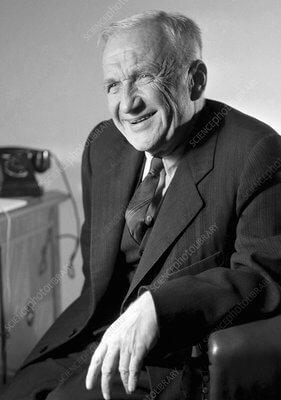
He is a Swiss physicist who jointly discovered the superconductivity in certain substances at higher temperatures than had previously been thought attainable. For this discovery, he shared the Nobel Prize with J. Georg Bednorz in 1987. The world was started after the reported superconductivity in a layered ceramic material at a temperature of 33 degrees above absolute zero. It led to new researches worldwide that gilded dozens of new superconductors.
Gerald S. Hawkins (20 Apr 1928 -26 May 2003)
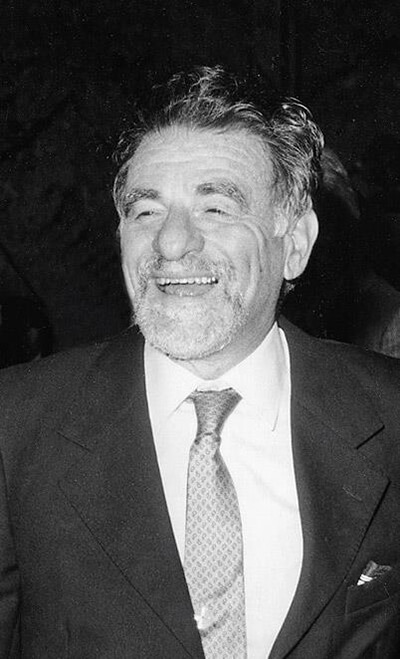
He was an English American radio astronomer and mathematician who noticed that the whole issue of trilithons and 19 bluestones open up in the direction of the midsummer sunrise. He used the computer to show that Stonehenge was a prehistoric astronomical observatory. He identified 165 key points that correlated the archaeological features of the Neolithic complex to the rising and setting positions of the Sun and moon. His first findings were published in the journal Nature in 1963. He also explored the mysteries of Machu Picchu and the Egyptian temples of Karnataka and Amon-Ra.
Kai Manne Börje Siegbahn (20 Apr 1918 - 20 Jul 2007)
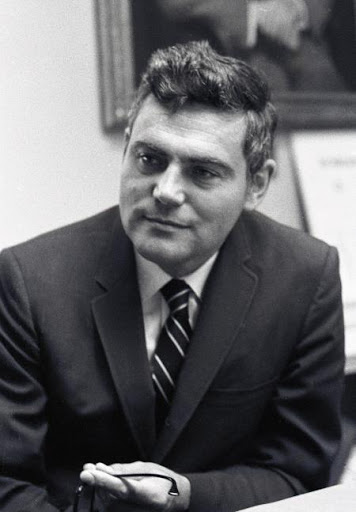
He was a Swedish physicist who analyzed the electrons that were knocked out from the interior of an atom by high-energy x-ray photons. It led to the development of high-resolution electron spectroscopy. For his contribution, he shared the Nobel Prize for Physics in 1981. With his methods, he could measure the binding energy of atomic electrons with higher accuracy than was previously possible and since the binding energy depends upon the chemical environment of the atom this provided a new tool of chemical analysis. ESCA is now used by hundreds of laboratories around the world to check surface reactions such as catalytic reactions.
James David Forbes (20 Apr 1809 - 31 Dec 1868)
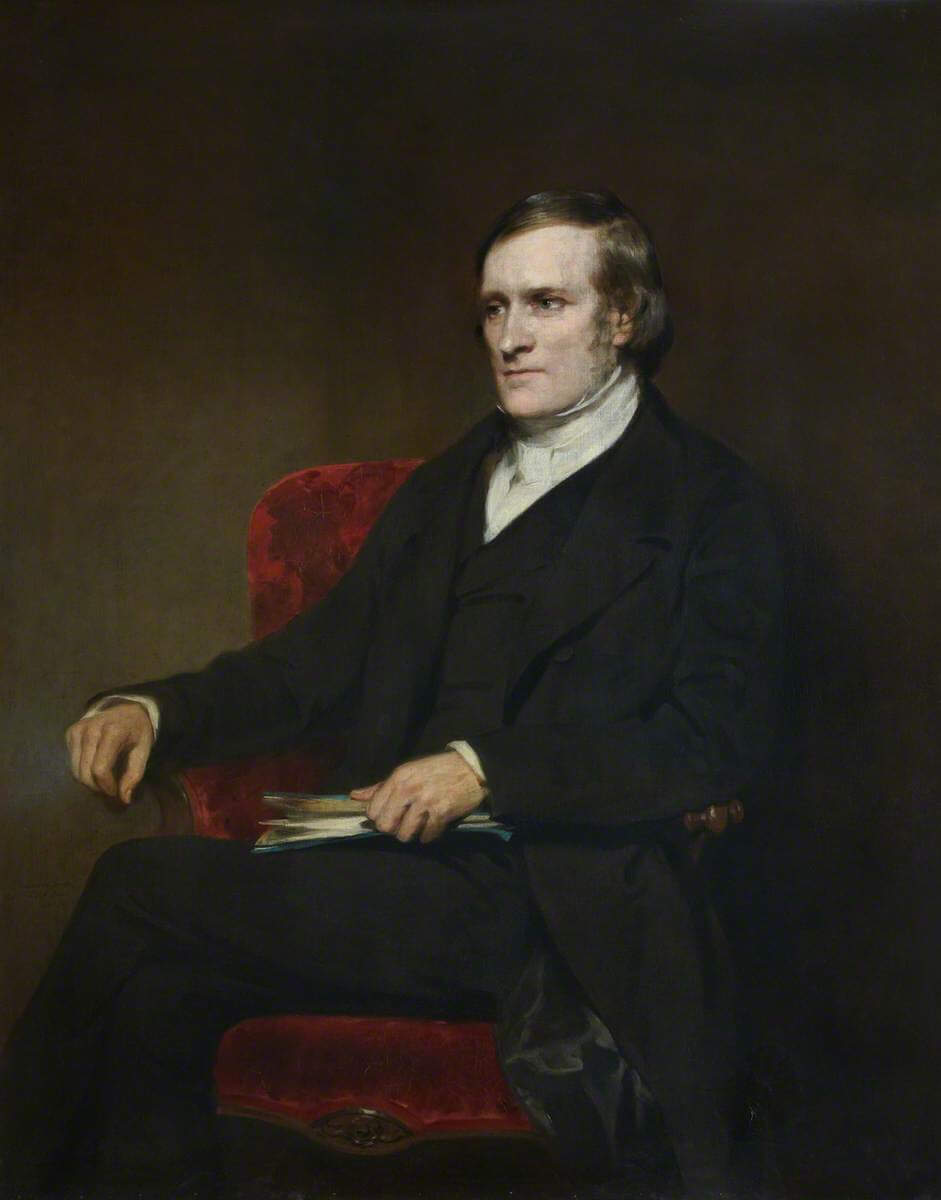
He was a Scottish physicist who was known for his research on heat conduction and glaciers. He begins experiments on the temperature of the earth at different depths and different soil and he also investigated the laws of heat conduction in bars. Later he also wrote a paper that reported that iron conducts heat less efficiently as its temperature rises. We also describe the polarization of radiant infrared heat. He was involved with Tyndall in the great glacier controversial of 1850 and he was also among the first to study glacier movements.
April 20 in Physics History - Deaths – Physicists died on April 20
John Goodricke (17 Sep 1764 - 20 Apr 1786)
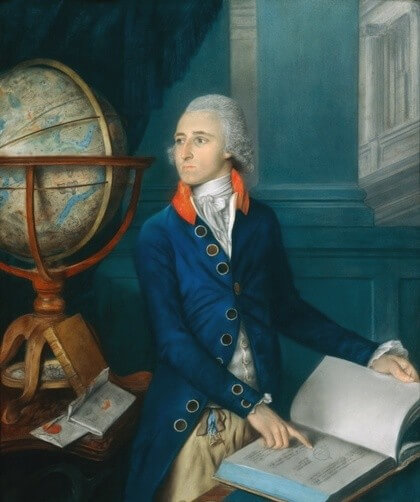
He was an English astronomer who was the first to calculate the period of Algol Star to 68 hours and 15 minutes. He was the first to notice that some variable stars with periodic and he also noticed that the distant sun is periodically occulted by a dark body. He was born a deaf-mute and after proper education, he was able to read lips and to speak. John was admitted to the Royal Society on 16 April 1786. But he died 4 days later from pneumonia.
Jean-Baptiste-Gaspard Bochart de Saron (16 Jan 1730 - 20 Apr 1794)

He was a French lawyer and natural scientist who assembled the significant collection of astronomical instruments made renowned craftsmen. He calculated orbits of comets with Charles Messier. His calculations help his friend find them again after they had disappeared behind the sun. He made calculations for Herschel’s comet which was later refined by Laplace and he also contributed to the discovery of Uranus.
Ferdinand Braun (6 Jun 1850 - 20 Apr 1918)

He was a German physicist who developed the wireless telegraphy with Guglielmo Marconi. He got the Nobel Prize for Physics in 1909. He also demonstrated the first cathode-ray oscilloscope in 1897 when he worked on high-frequency alternating currents. He wrote papers on the deviations from ohm’s law and also on the calculations of electromotive force from thermal sources. He produced a narrow stream of electrons that had previously been characterized by uncontrolled rays.
April 20 in Physics History - Events – Physics Events of April 20
The First Sample of Radioactive Element Radium
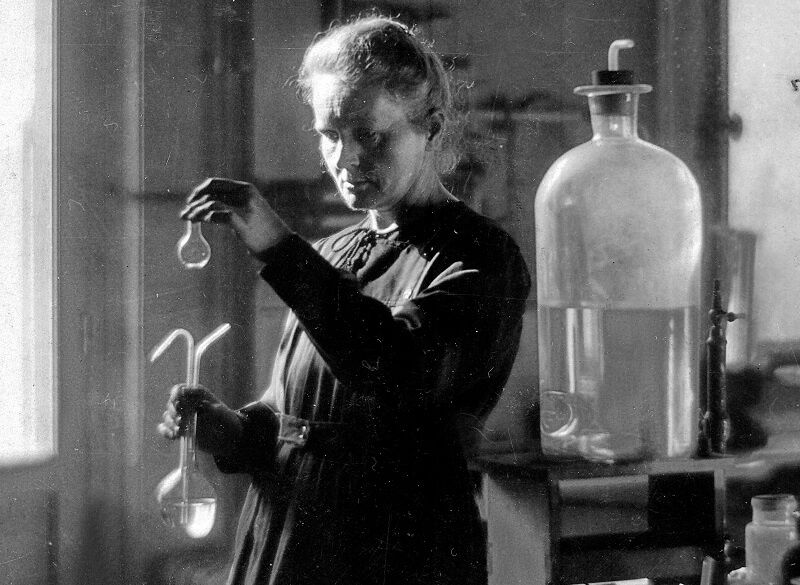
The first sample of the radioactive element, one gram of pure radium chloride was isolated by Pierre Curie and Marie Curie in 1902. They had to find it from the 8 tons of pitchblende ore. Further work they were awarded the doctorate of science degree in June 1903. Marie Curie and her husband were awarded the Nobel Prize for Physics in 1903. She continued her work and finally, she successfully isolated pure metallic radium in 1910. She again received the Nobel Prize in chemistry in 1911 and became the first person to win two Nobles.
The First US Electron Microscope
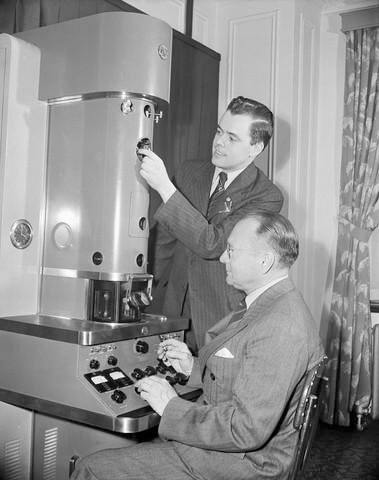
The first US electron microscope was invented in Philadelphia Pennsylvania in 1940. It was able to produce a magnification of 100000 times. This was invented by Dr. Vladimir Zworykin.